So Much Time

Time, Dust, and Eternity: A Look at “So Much Time” by Armando Heredia

Armando Heredia’s “So Much Time,” published through his musical project If We Were A Band, is a thought-provoking song that evolved from a short poem titled “Stardust.” This blog post will explore the journey from poem to song, analyze the emotional impact of the lyrics, and examine the profound ideas they present.

The poem, “Stardust,” was inspired by Heredia’s experience creating art from reclaimed materials. The act of sanding these materials, leaving his hands covered in dust, sparked a profound realization:

“We rarely realize that eternity speaks to us
through the very dust on our hands
Sunshine and starlight
reflect off of the residue

of our greatest plans”

This simple yet powerful imagery forms the core message of both the poem and the song.

“So Much Time” expands on the themes introduced in “Stardust,” delving deeper into the concepts of time, effort, and the fleeting nature of existence. The lyrics repeatedly emphasize the amount of time we spend focused on ourselves and our endeavors: “We spend so much time / looking at ourselves / So much effort to laud our own efforts”

This introspection, however, is juxtaposed with the stark reminder that “Nothing is forever”, a truth driven home by the repetition of the phrase throughout the song.

Let’s examine each stanza of “So Much Time” and analyze the feelings and ideas they evoke:

  • Stanza 1: The song begins with the lines, “We spend so much time / looking at ourselves / So much effort to laud our own efforts”. The repetition of “so much time” emphasizes how much we focus on ourselves and our accomplishments, perhaps to the detriment of other things. This introspection might evoke a sense of self-awareness, but also a tinge of regret for time wasted on self-absorption.
  • Stanza 2: This stanza introduces a contrasting element: “We have all of the tools / we need to make / permanent changes / to temporary things / But Nothing is forever”. These lines highlight the paradox of our existence. We strive for permanence, but we live in a temporary world. This realization can be sobering, reminding us of our limitations and the fleeting nature of our achievements. The repetition of “Nothing is forever,” reinforces this sense of impermanence and can lead to feelings of melancholy or even existential anxiety.
  • Stanza 3: Here, the song shifts its focus to a more philosophical perspective: “We rarely realize / that eternity speaks to us / through the very dust on our hands / Sunshine and starlight / reflect off of the residue of our greatest plans”. The “dust on our hands” becomes a powerful symbol of our efforts and experiences. The imagery of “eternity speak[ing] to us” through this dust elevates the mundane to something profound. This stanza invites us to see the connection between our everyday actions and the grand sweep of time. It can evoke a sense of awe and wonder about our place in the universe.
  • Stanza 4: This stanza seems to circle back to the themes of time and effort introduced earlier, but with a slightly different emphasis: “We spend so much time / Trading ourselves / So much effort to trade / The thing we can’t get back / For temporary things”. This time, the focus is on how we often waste our precious time chasing after things that don’t truly matter. The “thing we can’t get back” is likely a reference to time itself. This realization can be frustrating and even painful, prompting us to re-evaluate our priorities.
  • Stanza 5: The final stanza is short and to the point: “Make your trades / No refunds / What you see / Is what you get”. This could be interpreted as a call to accept responsibility for our choices. It suggests that we can’t undo the past, but we can learn from it and move forward with greater awareness. This final message can be both empowering and sobering, reminding us that we are ultimately accountable for how we spend our time.

“So Much Time” explores complex and often contradictory feelings. It encourages us to confront the reality of our limited time while also finding meaning in the present moment.

The emotional impact of “So Much Time” stems from its potent blend of melancholy and hope. The somber acknowledgment of our mortality is balanced by the awe-inspiring imagery of “eternity speak[ing] to us through the very dust on our hands.” This contrast highlights the beauty and significance of our fleeting moments on earth.

The song also encourages reflection on how we spend our time. We are reminded that we possess “all of the tools we need to make / permanent changes to temporary things.” This line invites listeners to consider their own actions and whether they are focused on truly meaningful endeavors. The lyrics further challenge us by stating, “We spend so much time / Trading ourselves / So much effort to trade / The thing we can’t get back / For temporary things” Here, the song critiques our tendency to sacrifice our precious time and energy for fleeting material possessions or superficial pursuits.

“So Much Time” is a poignant reminder to appreciate the present moment and to strive for something more lasting than temporary gratification. The song inspires introspection and encourages us to re-evaluate our priorities, urging us to invest our time wisely.

You can listen to “So Much Time” by If We Were A Band on the “This Time Is Different” albom on Apple Music and Spotify.

#SoMuchTime #IfWeWereABand #ArmandoHeredia #ThisTimeIsDifferent #Time #Eternity #MeaningfulLiving #Reflection

This Is The Prize

Reflections on Hustle Culture

This is the Prize: A Reflection on Artistic Legacy and Personal Fulfillment

Armando Heredia’s song “This Is The Prize” is a poignant reflection on the cost of success in the creative industry, drawing inspiration from Johnny Cash’s rendition of Nine Inch Nails’ “Hurt.” Examining the lyrics alongside Heredia’s own notes on the song’s creation reveals a powerful message about the potential pitfalls of relentless ambition and the true value of personal connection.

The Influence of “Hurt”

Heredia explicitly acknowledges the influence of Johnny Cash’s “Hurt” in his writer’s note. He describes being struck by the image of Cash, at the end of his career, singing someone else’s song about pain and sacrifice. This image serves as a starting point for Heredia’s exploration of the reward for a life dedicated to creative pursuits.

The lyrics of “Hurt” itself provide a stark backdrop for Heredia’s reflection. Cash’s raw and vulnerable performance amplifies the song’s themes of regret, isolation, and the fleeting nature of earthly possessions. Lines like “What have I become, my sweetest friend? / Everyone I know goes away in the end,” and “And you could have it all, my empire of dirt,” resonate with Heredia’s own questioning of the value of worldly success.

The Cost of the Grind

Heredia’s lyrics echo the weariness and disillusionment hinted at in “Hurt.” He questions “what’s the prize at the end?” and “what do we get for the grind?”. These questions highlight the potential for burnout and disillusionment inherent in the relentless pursuit of artistic success.

Heredia paints a picture of his own grueling schedule, working tirelessly on his own projects before and after his day job. This “hustle and grind” mentality, while seemingly necessary in a competitive industry, leads him to question whether the ultimate prize is worth the personal cost. He wonders if the end result is simply to “end up like Cash, at the end of the day / Sitting at a banquet table / singing someone else’s song about being hurt and giving it all away?”.

Redefining the Prize

However, “This Is The Prize” is not simply a lament for lost time or a cautionary tale against ambition. Instead, Heredia shifts the focus from external validation to internal fulfillment. He suggests that the true prize lies not in material success or recognition but in genuine human connection and creative expression.

The turning point comes with the repeated phrase “What if?” Heredia challenges the conventional markers of success, suggesting that perhaps “all I needed all along was you, and me, and this song”. This simple statement reframes the narrative, prioritizing love, companionship, and the inherent joy of artistic creation.

Heredia rejects the pursuit of “things that they say are important” choosing instead to find contentment in a life free from the pressure of external validation. He imagines a scenario where he can “sit with” someone he loves, unburdened by the distractions of “what the world is hawking”.

The True Reward

Ultimately, Heredia concludes that “this is the prize at the end”. The repetition of this phrase emphasizes a shift in perspective. The true reward is not the “empire of dirt” but the simple act of creation and connection. The prize is the song itself, the shared experience, and the freedom from the relentless pursuit of more.

By drawing inspiration from Johnny Cash’s interpretation of “Hurt,” Heredia crafts a powerful message about the importance of finding meaning beyond the trappings of success. “This Is The Prize” serves as a reminder that the most valuable rewards are often found in the simple joys of life and the connections we forge with others.

This Is The Prize is the title song of an EP by the same name. It is available on most music platforms including Apple Music and Spotify.

The Banksy Advantage

Written By Armando Heredia


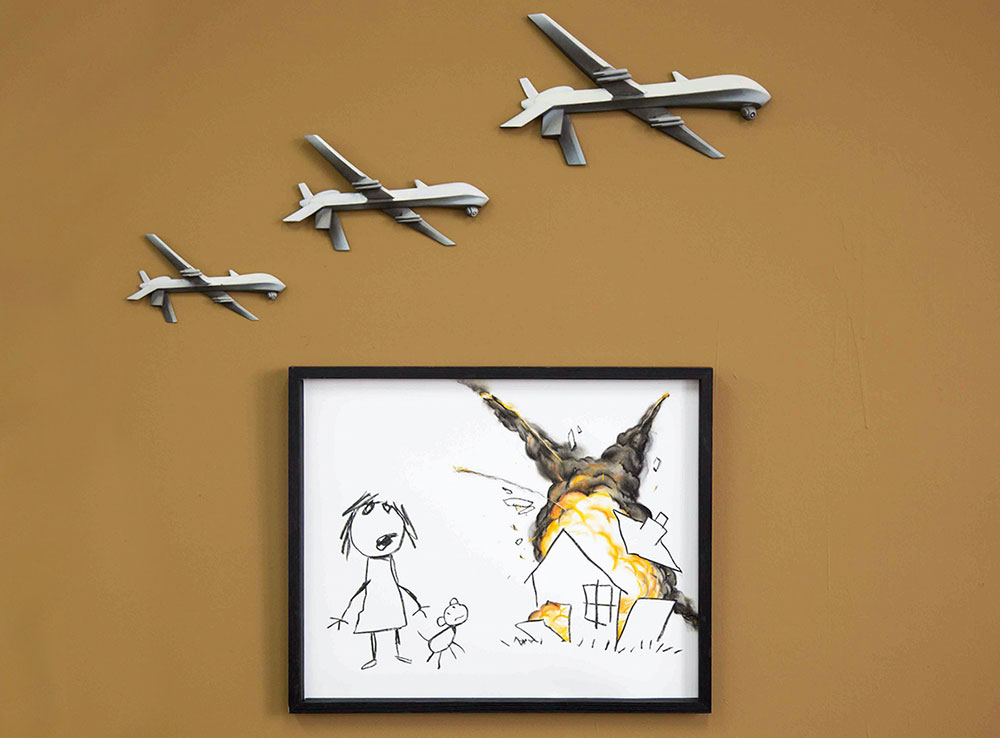
What created the type of scenario that would lead to a local street artist to become an international icon? Banksy is known the world over, not just in the street art circles, but in all echelons of artistic pop culture.

To speak, and to be a conscientious voice, speaking truth to power, outside of what is typically an “accepted” or even common method creates a different dynamic.

Personal risk creates an illusion of altruism, which may or may not be the case. Robin Hood was a thief, he was also considered to be a philanthropist, and a hero to the poor.

Had he been one or the other, he may not have been remembered as either.
This is not an argument for our efforts to be criminal, but to be unconventional.

At the end of the day, Banksy is both an artist, and a criminal, a genius and a vandal, and we know him because he is both of those things.

How do we apply the Banksy advantage to our work? It’s distilled in one word: notoriety. The notoriety that comes from working outside of social norms is the Banksy advantage.

What thing are you doing differently with your work that you could become notorious? What rule, or norm are you working outside of, or breaking completely, in the way you are accomplishing your efforts?

Again, I’m not advocating illegalities, but unconventionalities.

Lament for Icarus

We focus on the failure of weakness, the weakness of wax, but forget to celebrate the leap.

Years ago, my brother bought a large art piece from me. I was in a bind financially, and he had some extra funds. However, the piece was rather large, and the cost of shipping so high, that I ended up “holding” the piece. It has a temporarily permanent space in my stairwell. The art is a bas-relief sculpture of the fall of Icarus made from upcycled construction debris.

It’s so easy to default to failure.

At the time my focus was on creating work from found objects, and developing art inspired by the shape of the object. The scrap I found was tall and narrow and immediately inspired the idea of Icarus. The image I had in my mind was of that moment when, in his pride and disregard, he plummets to the ocean.

My brother pointed out something to me: the fall of Icarus is not the story. The real story is the jump.

“I am paralyzed with hope.1

How often have we not succeeded in a new work or an important project because we were afraid to fail? Much less than we realize, in my opinion. More often than not, we don’t succeed because we are afraid of the jump.

INFI

If not famous, infamous.

There are those whose names we know for good reason. They have acquired a fame, for a talent, skill or action.

Some we know for no good reason. They were at the right place, at the right time. Maybe they were associated with a person or event and co-opted the notoriety. Others, however, have earned a place of infamy, they’re not famous, instead they are the infamous.

Infamous: deserving of or causing an evil reputation; shamefully malign; detestable. (Dictionary.com)

How can we push the boundaries of infamy to a place of acceptance, and even adoption and/or adaptation? Banksy has realized that in order for him to survive and thrive in his criminal activities, he would have to become more proficient in his law-breaking effort. He adapted his technique and succeeded in first creating a reputation as a graffiti artist, not by being the best, but by being fast.

By adopting stencils into his work, Banksy was able to create and replicate his work quickly, which gave him the advantage of time, so he was able to do larger, more complex work. This is where his voice was amplified, like a megaphone, and moved him out of the realm of infamy, into fame (at least where the non-law enforcement public was concerned).

What is your megaphone? What are you doing that not only had a voice, but needs amplification?

  1. Roni Horn ↩︎