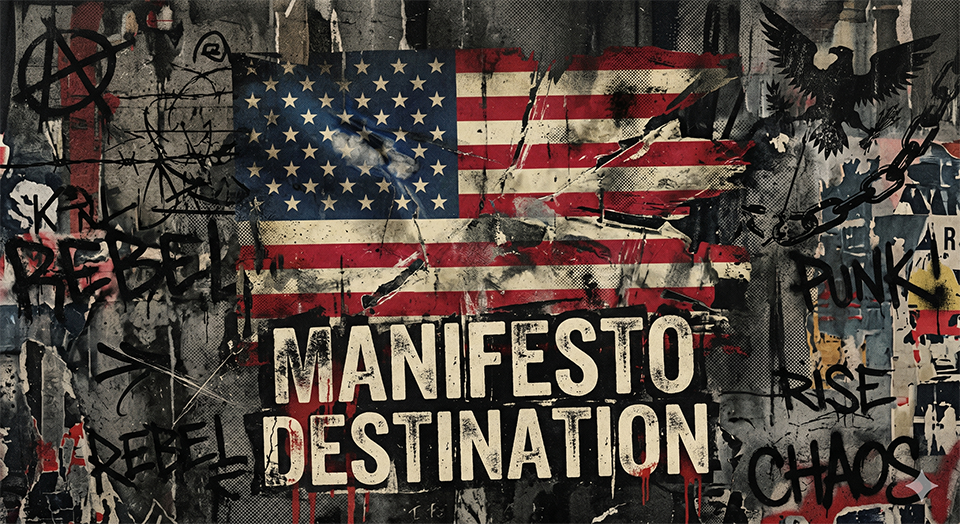
A Collection of Poems By Armando Heredia Copyright 2026. ArmandoCreative, LLC
Read a review of Manifesto Destination
Playbook
Written by Armando Heredia

Injustice
Veiled by the predominant
Religious structure
In the name of the father
Son and the Holy Ghost
Whoever gets first
Gets the most

Aggression
Assailed by the dominant
Colonial culture
Colonies and provinces
Established on lands
Taken from savages
At least, that’s the story told
To justify soil fertilized with blood

Dispossession
Deceived by the prominent
Judicial infrastructure
A trail of tears on every continent
Misdeeds and broken treaties
Genocide and atrocities

This is the playbook
The anatomy of a body politic
That works its best tricks
In broad daylight
By using sleight of hand
And disillusionment
To steal from the populace
Of every land and territory
They’ve ever put their foot on

Manifest destiny
Manifestos and blasphemy
Church bells and holy water
Slave trade and slaughter
Oh, these were the human traffickers
Before it became the buzz word
Of the modern crusaders

This is the playbook
The anatomy of a body politic
That works its best tricks
In broad daylight
Blood lust and war mongers
They take wrong and make it wronger
Scripture quoting murderers
Patriarchal pariah masqueraders
Pulp fiction and contradictions
War crimes and future extraditions

Injustice
Veiled by the predominant
Aggression
Assailed by the dominant
Dispossession
Deceived by the prominent
This is the playbook
The anatomy of a body politic
The End Is Near
Written by Armando Heredia

The End is Near
There’s a man on the street corner
Shouting a message into a megaphone
He’s not particularly loquacious
But his language is spectacularly audacious
He shouts at the top of his lungs

The end is near, the end, oh, the end
Is nearer than you think so
You better be afraid, cause you’re a sinner
And my God
Oh my God
My God hates you

There’s another man at the cemetery
To protest your man’s funeral and
And, he’s there to let you know
That
The end, the end
Is nearer than you think so
You better be afraid
Cause you’re a sinner
And my God
Oh my God
My God hates you
Yeah

Two hundred and fifty years ago
Their forefathers landed at Plymouth Rock
And they saw that manifest destiny ah
And shouted their manifesto
To the people in the way
They said
The end is near
The end, the end
Is nearer than you think so
You better be afraid, cause you’re a sinner
And my God
Oh my God
My God hates you

And oh they shout
It’s us, it’s us
We are the end
That’s nearer than you think
We bring the hate that
Pushes it to the brink
Vanity and Destruction
In our pride and arrogance
They’re not particularly loquacious
But their language is spectacularly audacious
And they shout at the top of their lungs

It’s us, it’s us
We are the end
That’s nearer than you think
We bring the hate that
Pushes it to the brink
Vanity and Destruction
In our pride and arrogance
Vanity and Destruction
They’re not particularly loquacious
But their language is spectacularly audacious

And my God
Oh
My
God
My God hates you

And my God
Oh my God
My God hates you
And, and they’re there
To let you know that
The end, the end
Is nearer than you think so
You better be afraid
Cause you’re a sinner
And my God
Oh my God
My God hates you

They say
The end
The end
The end is near
I am so afraid
Cause I’m a sinner
And my God
Oh my God
My God hates me
And if he hates me
Oh if he hates me
He’s gotta hate you, too
Oh They say
That’s what they say
American Nuance
By Armando Heredia

Some people say they don’t see skin color
Well, they can't see grayscale nuance either
Can't even see black and white
Because all they see is white

I’m not saying all white people
Are racist but
Maybe racism is really just escapism
Trying to make the world around you
Look like the world in your head
The fantasy island where you
Look like everyone who looks like you, too

Aw, you’re so afraid of the one
Who doesn’t fit the pattern you imagined
Even your Jesus gets the treatment
Now His eyes are blue and skin is light
Blond hair and pearly whites
Hanging in a golden frame
So pious in your little white church

The hero in all your stories
Like The Lone Ranger
The white savior
Your missionaries
Your emissaries
Bringing whiteness to the plains
In the guise of Christ
But, it was never really about sharing Jesus
It was just you trying to say that
They can’t be white, but should try to be like us
You cut their hair and put ‘em in your suit
You stole their land and language
You took away their rights
And tried to make them feel like less
Because they weren’t white
Like your Jesus

But, it never was about Jesus
He was brown
It never was about Jesus
Or you would have never cut them down
It was never about Jesus
Never about the light
Never about love
Never about the kingdom above
It was never about Jesus
He wasn’t white

And you lift your eyes to heaven
And thank your God in prayer
And your porcelain blue eyed Jesus
Smiles his pearly whites

But, It never was about Jesus
He was brown
It never was about Jesus
Or you would have never cut them down
It was never about Jesus
Never about the Light
Never about love
Never about the kingdom above
It was never about Jesus
He wasn’t white

Oh I don’t see skin color you say
And I believe you
I believe you
You made a believer out of me
The Dominant Strain
By Armando Heredia

It’s passed on in the genes, you say
But you gotta look at the in betweens
You’d say This is the alpha blend
The eugenicological result of the dominant strain
The only thing that makes sense
In your brain

But the truth is a mixed bag, my friend
Cause, the genes that make you
Are diluted by the very thing
That makes you pure, in the end
Twisting off to be with your own kind
The gene pool’s deep and wide
But you’re floating off to the shallow side
And there’s still bleach in the water
From trying to force out the others

You think you're the dominant strain
Working so hard to not have to compete again
Yeah, all you did was subtract
Cause we all go back
To that same body
But you Cut out the browns
Cut out the blacks
No yellow, no red
And as a matter of fact
Some whites don’t make the cut, oddly

Even Adam and Eve, naked in the jungles of Africa
Would’ve been kicked out of your Eden
Cause they were mixed blood, right
But The dominant strain is just human
Not white
Not black
Not yellow
Not red
Not brown

And you think your the dominant strain
Working so hard to not have to compete
But subtraction isn’t how you grow
And to spite your own face
You’d cut off your nose

Oh, You think you’re superior
How can I make this clearer
The dominant strain is just human
Not white
Black
Yellow
Red
Or brown

So sell your genes
Yeah drop an ad
Yo, sell that denim
With that eagle brand
Register with the party
Haha, that’s a good one
But don’t forget that
The genes that make you
Are diluted by the very thing
That you say makes you pure
Twisting off to be with your own kind
The gene pool’s deep and wide
But you’re floating to the shallow side
And there’s still bleach in the water
From trying to force out the others

Twisting off to be with your own kind
Floating off into the shallow side
The shallow side

Bleach in the water
On the shallow side
The Winner Makes The Rules
Written by Armando Heredia

We shared our heritage by telling stories
From elder to younger by word of mouth
Nobody knew we existed
Until you came and called us your discovery
We were savages you insisted

You see
Life’s not about winning or losing
It’s about winning
Cause the loser doesn’t make the rules

The winner writes the hist’ry books
Frames the way it looks
To be who you think you are
Or who they say they were

They’re the ones who discover
The ones who plant their flag
Stolen artifacts
On display and dared us to object
Said they were the heroes
As a matter of fact
Because the winner
Yeah the winner gets to brag
The winner makes the rules

Who writes the stories
Who claims the heroes
Who makes the villains
Who made you the villain
And not the champion

Who owns the press
That makes the books
And who owns the schools
The winner makes the rules
Yeah, the winner makes the rules

And What about  this war between us
If I win, well
If I win
Nobody will even remember your name
Yeah, those are the rules
The winner owns the game
Yeah, The winner owns the game

Now the winner re-writes the hist’ry books
And re-frames the way it looks
To be who you think you were
Or who they say they are

Who wrote the score
Who do you think you are
Yeah, who do you think you are
You’re who they say you are
Unless you win
Because the winner makes the rules

No, life is not about winning or losing
It’s about winning
Because the loser doesn’t make
The rules the loser doesn’t
Make the rules
The loser doesn’t make the rules
Manifesto Destination
Written by Armando Heredia

Broken doesn’t happen in a vacuum
Mental health and despair
Government slush funds
And debilitating insurance regulations

It’s a manifesto destination
Like a travel guide to the darker side
People beat down by this thing called life
PTSD and unresolved grief
CEO bonuses and corporate thieves
Hard working people with no hope
Without the capacity to cope

Yeah,
It’s a manifesto destination
Lines and lines of grievances
The United States of atrocities
And it’s all a culmination

Lines on lines written on crumpled paper
Lines on lines scratched into prison walls
Lines on lines emailed to the papers
Lines on lines on lines on lines

Teenage boys, and wounded soldiers
Grieving sons and disgruntled workers
It’s a manifesto destination
Welcome to the present tense
And everything is so tense
You could cut it with a knife
But that wasn’t in the plan

What did you think would happen
If you pushed them all into a corner
Who did you think you’d have to call
If not the counselor, the coroner

And they wrote it all down
But you read it too late
And they wrote it all down
But you failed to evacuate
And they wrote it all down
But you never…

This is a manifesto destination
And we’ve got a ticket to ride

Overworked and underpaid
Undervalued and overtaxed
Overlooked and misunderstood
Under pressure and overwhelmed

It’s a
It’s a
A manifesto destination
Manifesto destination
Manifesto
Destination
Where do we go from here

Did you get the package
Did you see the baggage
Do you think you can manage
To contain the damage
Where do we go from here
Where do we go now
The Manifesto Destination: A Review
Armando Heredia’s Manifesto Destination is a blistering spoken-word critique of American history and modern society. His voice is totally confrontational. It perfectly matches the raw energy of the punk rock genre it was written for. He relies heavily on repetition and rhythmic pacing to drive his points home, using a casual but piercing vocabulary. The literary merit here is all about blunt force. No flowery prose. Just stark observations about hypocrisy and societal collapse.
The whole collection hits hard on the American sociopolitical landscape. Heredia draws a straight line from early colonialism and “Manifest destiny” right to modern crises like mass shootings and corporate greed. He explores how historical atrocities were justified using religion and white supremacy. It really challenges the sanitized version of history we usually get. He demands you confront the “anatomy of a body politic” built on dispossession and violence.
Playbook
This opening track is basically the thesis statement for the entire project. It focuses on how religion and government get weaponized to justify colonialism and theft. Heredia breaks down the systemic nature of oppression. He calls it an “anatomy of a body politic.” He takes a sharp look at how religious structures (“In the name of the father / Son and the Holy Ghost”) hid injustice and land theft from Indigenous populations. He calls out the hypocrisy of modern “crusaders” by pointing out the original colonizers were the actual “human traffickers.” The repetition makes it clear. This cycle of violence isn’t an accident. It’s a deliberate “playbook.”
The End Is Near
Here we get straight into religious extremism and hate speech. This piece examines the doom and hatred pushed by fundamentalist figures, like street corner preachers or funeral protesters. Heredia connects this modern vitriol directly to the “forefathers” at Plymouth Rock. He argues they brought a similar manifesto of fear. The repetition of “my God hates you” really shows the absurdity and cruelty of weaponizing divinity. Then he flips the script. He suggests the real “destruction” comes from the preachers’ own pride and arrogance.
American Nuance
Heredia goes after the fallacy of racial “colorblindness” and the whitewashing of Christianity. He delivers a cutting critique of people claiming they “don’t see skin color.” He argues that stance is really just an inability to see anything but whiteness. It’s pure escapism into a fantasy world of homogeneity. The poem then tackles how marginalized cultures were destroyed under the guise of Christian missions. Colonizers “stole their land and language” while pushing a blue-eyed, blond-haired Jesus. The repeated refrain of “It was never about Jesus / He was brown” is a powerful historical correction. Such a strong condemnation of religious hypocrisy.
The Dominant Strain
This one dismantles the myth of genetic superiority. Heredia uses a gene pool metaphor to mock people isolating themselves. He says they’re floating to the “shallow side” where there’s “bleach in the water.” He points out the historical absurdity of white purity by referencing human origins in Africa. He notes even Adam and Eve “would’ve been kicked out of your Eden” because they were mixed blood. The core message is a unifying but aggressive reality check. “The dominant strain is just human.”
The Winner Makes The Rules
Heredia explores how history is written by the victors. He starts from the perspective of an oral culture (“We shared our heritage by telling stories”) that gets suddenly “discovered” and labeled as “savages.” The poem argues winning and losing is really about who gets to control the narrative. “The winner re-writes the hist’ry books” and “makes the villains.” It’s a heavy commentary on how systemic power controls education and collective memory.
Manifesto Destination
The final piece shifts away from historical critique into a bleak modern reality. It focuses on societal collapse and the boiling point of the American working class. Heredia lists the heavy pressures of contemporary life like “Government slush funds” and “PTSD.” He paints a picture of a society pushing its citizens into corners. Teenage boys and wounded soldiers. Disgruntled workers. The title refers to the tragic modern trend of people writing manifestos before committing mass violence. He characterizes these as lines “emailed to the papers” or “scratched into prison walls.” The poem ends on a chilling, unresolved note. He asks, “Where do we go from here.” It leaves you to grapple with the “United States of atrocities” he just outlined.