Chasing the Sun

A Literary Review of Armando Heredia’s “Chasing the Sun”

Armando Heredia’s triptych, Chasing the Sun, is a profound and cohesive exploration of the American mythos of escape and the complex, often painful, reconciliation with one’s roots. Presented as three distinct yet interconnected poems—“Dream Sequence,” “Chasing the Sun,” and “Head’n West”—the collection functions as a nuanced narrative arc, moving from inherited longing, through the act of departure, and culminating in a weary but purposeful return. It is a masterful study of how legacy, memory, and landscape shape identity.

I. “Dream Sequence”: The Haunting of Legacy

The collection opens not in the physical world, but “back in the ether,” establishing memory and familial influence as the primordial forces driving the narrative. Heredia deftly uses fragmented, almost ghostly imagery to build a foundation of inherited restlessness. The figures of the father, the brother (“almost a stranger”), and the uncle are not fully realized characters but mythic archetypes, “spoken only in whispered tones.” This deliberate vagueness universalizes them; they become every family’s stories of adventure and danger that tantalize the next generation.

The poem’s power lies in its refrain: “That makes me want to ride.” The verb “ride” is crucially ambiguous—evoking both the motorcycle of the uncle’s “v-twin” and the train that becomes a central symbol in the following poem. It is a primal urge, passed down like a genetic trait, suggesting that the desire to escape is itself a form of inheritance. The repetition of “danger” and “whispers” creates a hypnotic, compulsive rhythm, mirroring the inescapable pull of a destiny one did not choose.

II. “Chasing the Sun”: The Bittersweet Act of Escape

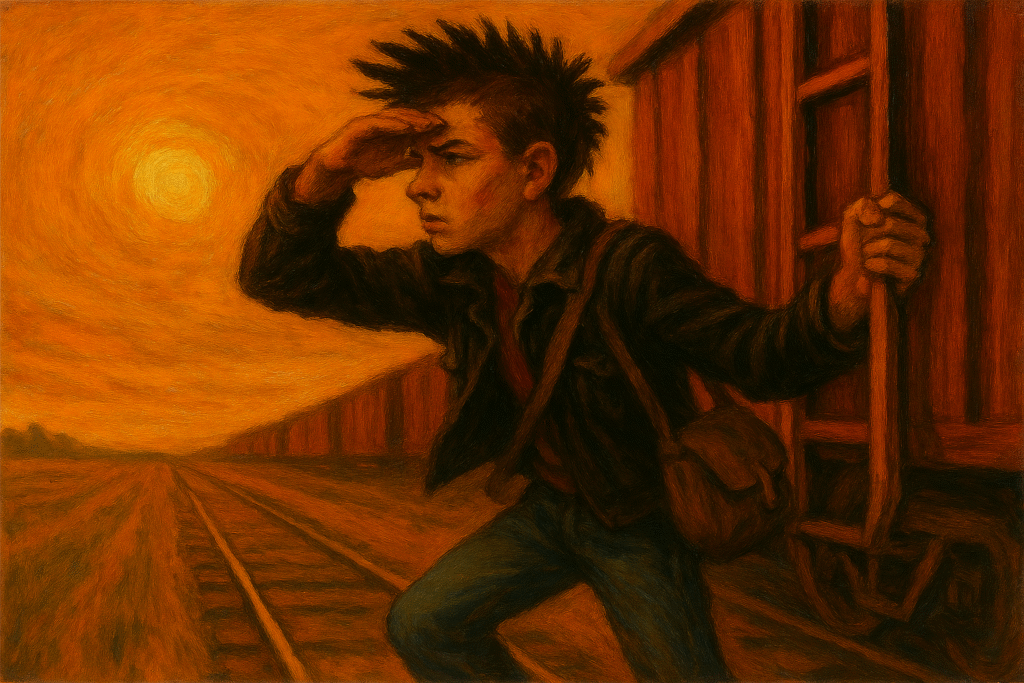
Where “Dream Sequence” is all haunting potential, the titular second poem crashes into the reality of action. Heredia captures the quintessential youthful idealism of small-town life with the potent image of “Boys playing at the tracks,” who “swore we’d board the train / Someday, and Never look back.” The capitalizations on “Someday” and “Never” elevate these concepts from mere words to sacred vows, highlighting the absolute faith of youth in a future elsewhere.

The poem’s central tension is revealed not in the escape itself, but in its aftermath. The poignant receipt of a letter reveals a friend who has “finally caught that train,” yet the victory is undercut by a profound melancholy. Heredia subverts the classic escape narrative with the brilliant line: “But you’re still facing west / Cause maybe this is better / But you’re still looking for best.” This exposes the perpetual motion of desire—the sun, the symbol of a better life, is always on the horizon, forever receding. The pleading refrain, “Oh, someone stop the sun,” is a cry of existential exhaustion, a realization that the chase is endless and daylight—time, opportunity, youth—is always running out.

III. “Head’n West”: The Circular Journey Home

The final poem represents a stunning and mature resolution to the collection’s central conflict. The direction remains “west,” but the motivation has fundamentally shifted. No longer is it a frantic “chase”; it is now “Driving into the sunset,” which is explicitly equated with “head’n home.” The journey has come full circle, both geographically and emotionally.

Heredia introduces a layer of profound literary depth through introspection and regret—elements absent from the naive fantasies of the previous poems. The confession, “I won’t lie and say I wouldn’t change a thing,” is a moment of stunning vulnerability. He rejects facile clichés of regret-free living, instead acknowledging that “those regrets / Made this journey harder than it need be / And the who they made me / Isn’t the me I planned to be.” This is the core of the collection’s wisdom: identity is not a pristine plan achieved but a mosaic built from choices, mistakes, and detours.

The imagery softens from the sharp, dramatic symbols of trains and tracks to the gentle, natural fading of light: “the stars are flickerin’,” “an Orange horizon line / Under an indigo blue sky.” The mood is no longer one of frantic pursuit but of quiet acceptance and weary resolution. The journey ends not at a dramatic destination, but simply “where it ends,” in the peace of returning “back to you, back where I belong.”

Conclusion: A Unified American Lyric

As a triptych, Chasing the Sun succeeds as a unified and powerful literary work. Heredia weaves a consistent symbolic tapestry—trains, wheels, horizons, and familial ghosts—to explore the cyclical nature of seeking. The collection argues that the true journey is not about merely arriving at a new place, but about understanding the forces that propelled you forward and ultimately integrating that understanding into a sense of self and home.

It is a deeply American narrative, echoing the spirit of Whitman and Kerouac, but filtered through a modern, introspective lens that values emotional truth over romanticized adventure. Heredia’s work is a poignant reminder that we often must chase the sun to the highway’s end only to discover that home was both the point of origin and the final destination all along.
The System Says

Through a Glass, Darkly: A Literary Analysis of Armando Heredia’s “The System Says”

In an era of curated social media feeds and algorithmic influence, the question of what defines our value has never more potent. Armando Heredia’s poetry collection, The System Says, arrives as a vital, unsettling mirror held up to both society and the self. It is a work that masterfully intertwines the external critique of societal systems with a brutal, internal excavation of personal hypocrisy, creating a cohesive and powerful examination of modern identity.

The Central Theme: The Anatomy of a System

At its core, The System Says is a dissection of “The System”—an amorphous yet all-powerful entity that encompasses capitalism, social hierarchy, and the unspoken rules of status and value. Heredia doesn’t just rage against this machine; he meticulously documents its mechanics.

The poem “How Upper Echelon of You” attacks the illusion of status with scathing irony. The image of the elite “squinting from the glare / Of all your golden cows” is a brilliant modern metaphor for idolatry of wealth. Heredia reduces the “upper crust” to mere “flakes held together By their dough,” arguing that their cohesion is not based on character or merit, but on capital alone. The repeated, mocking refrain—“How upper echelon of you”—is a verbal eye-roll, a weaponized phrase that exposes the performative absurdity of social climbing.

This critique is expanded in “What they want,” which explores how the system consumes individuality. The poignant story of the sister whose hair is loved, then cut off and colored from a bottle, serves as a perfect metaphor for commodification. The system doesn’t want you; it wants what it can mold you into. The poem’s relentless, chanting conclusion—“Commodification / Capitalization”—functions like a hammer driving home a nail. It removes the complex facade to reveal the brutal, simple transaction underneath all interaction: “It’s not about who you are / But what they can do with you.”

The Introspective Turn: The System Within

What elevates this collection from a simple protest to a profound literary work is its inward turn. The system isn’t just out there; it’s internalized. This is most powerfully explored in “Dirty Filthy Heart,” the collection’s masterstroke and emotional core.

The poem begins with an external judgment of a homeless man, deemed filthy and out of place. The narrator, confessing to being part of “the elite,” casts this judgment. But in a stunning volta, the gaze turns inward: “Then I was reminded of this heart of mine / That grows like a tangled mess of vines.” The narrator realizes the true filth isn’t on the outside but within—a heart filled with “lust, the malice and my narcissism / Pride and arrogance, my own bitter prison.”

The act of kicking his own heart “out on the street” is a breathtaking act of self-condemnation. By declaring his own soul the “most raggedy thing you’ll ever meet,” Heredia makes a profound argument: that our outward participation in systems of judgment and hierarchy is a direct reflection of our own internal brokenness. We reject in others what we fear and refuse to acknowledge in ourselves.

Literary Devices and Structure

Heredia employs several effective devices to convey his message:

  • Irony and Sarcasm: The title phrase “How Upper Echelon of You” is dripping with ironic praise, immediately setting a tone of critical observation.
  • Metaphor: The collection is rich with them. The “golden cows” of idolatry, the “tangled mess of vines” representing a sinful heart, and the entire concept of “Art is wildlife management” from a previous collection all show a poet thinking deeply in figurative language.
  • Repetition and Refrain: The obsessive repetition of “Obviously” in “Dirty Filthy Heart” mirrors the relentless, dehumanizing judgment of society. The chanting of “Commodification / Capitalization” in “What they want” mimics the grinding, repetitive nature of the system itself, beating the listener into submission.
  • Contrast: The collection is built on contrasts: clean vs. filthy, elite vs. ragged, internal vs. external, who you are vs. what they can do with you. This structural tension is what gives the poems their enduring power.

Why This Collection Matters

The System Says is important because it offers more than just criticism; it offers a diagnosis. It identifies the illness not just in our institutions but in the human condition itself. It’s a collection for anyone who has ever felt reduced to a product, a number, or a status symbol, while also challenging that same person to confront their own complicity.

It is a punk rock sermon in poetic form, refusing to let the reader off the hook. It forces us to ask: Whose system are we following? And what filthy, beautiful, authentic parts of ourselves have we had to lock away to survive within it? In holding up that mirror, Armando Heredia hasn’t just written poems; he’s created a crucial commentary for our times.

You and Me

You and Me

Armando Heredia’s collection, You and Me, is a poignant and cohesive examination of modern love, commitment, and the search for meaning beyond societal expectations. Through four distinct yet harmoniously linked poems, Heredia constructs a narrative that is less about romantic idealism and more about the grounded, resilient, and conscious choice to build a life with another person.

Individual Poem Analyses

1. This is the Prize
This opening poem serves as the philosophical anchor of the entire collection. It immediately establishes the central conflict: the external “grind” and “hustle” versus the internal search for value. Heredia masterfully employs intertextuality, invoking the spectral presence of Johnny Cash—specifically his haunting cover of “Hurt”—to symbolize the hollow victory of material success (“empire of dirt,” “banquet table”).

The poem’s structure mirrors a internal debate, moving from questioning to defiant realization. The powerful anaphora of “What if” marks the crucial turning point, where the speaker rejects the prescribed path of kings and rulers. The “prize” is radically redefined not as an object to be won, but as a state of being: presence with a loved one, free from the distracting “hawking” of the world. It’s a manifesto for prioritizing human connection over capitalist ambition.

2. You and Me
If the first poem is the thesis, this poem is its emotional proof. The tone shifts from philosophical questioning to steadfast assurance. Heredia uses a simple, almost conversational refrain—”You and me”—to build a rhythm of reliability and shared history. The imagery is grounded in tangible experiences: “storms,” geographic journeys from “Missouri to California,” and witnessing sunrises and sunsets on opposing coasts.

This poem functions as a vow, but not one made in a grand ceremony. It is a daily, practical promise encapsulated in the powerful lines: “I’ll fly, drive, walk if I have to… I’ll be there, just give me a call.” The commitment is active and unwavering, emphasizing that true love is shown not just in feeling, but in the willingness to traverse any distance, physical or emotional.

3. It’s Gonna be Me and You
Here, Heredia introduces a playful yet profound intertextual layer with the “pina colada” trope, a clear reference to the escapist fantasy of the 1970s hit song “Escape.” By explicitly rejecting this narrative—”I’ve never had a pina colada / I’m not looking for someone new”—the speaker affirms that their love is not about finding a perfect match for hobbies, but a deep, soul-level commitment to the person they already have.

The metaphor of the “new mixtape / of the song that is you” is brilliantly modern and tender. It suggests that a person is not a static “old recording” (a clever rebuttal to the Holmes reference) but a dynamic collection of stories, memories, and qualities that can be rediscovered and re-appreciated endlessly. This poem celebrates the joy of choosing your partner again and again.

4. Til the End
The final poem is a graceful synthesis of the collection’s themes. It returns to the contemplative “What if” of the first poem but applies it directly to the endurance of a relationship. Heredia beautifully captures the essence of a mature, lasting love: it is “not perfect, but it’s a perfect blend / Of mistakes and apologies / Forgiveness and amends.”

The imagery of the sunset—”watch the orange fade into that indigo blue sky”—is both beautiful and melancholic, acknowledging the inevitable passage of time while framing it as something to be faced together. The poem’s strength lies in its honest admission of hardship (“it’s hard, and things have been broken”) while simultaneously affirming the power of being “present, again and again.” It is a quiet, powerful conclusion that defines love as a persistent act of will and grace.

Review of the Collection as a Whole

As a collection, You and Me is a remarkably coherent and moving work. Heredia develops a clear arc: from questioning society’s definition of success, to affirming a chosen commitment, to playfully rejecting alternatives, and finally, to accepting the beautiful, imperfect reality of a lifelong partnership.

The recurring motifs—journeys (roads, flights, coasts), music (songs, mixtapes, recordings), and imperfection—create a rich tapestry that binds the poems together. The language is accessible yet deeply evocative, avoiding cliché in favor of raw, authentic emotion. The collection’s greatest achievement is its redefinition of “the prize.” It successfully argues that in a world of noise and hollow offers, the ultimate act of rebellion and fulfillment is to choose quiet presence with another person, “til the very end.”

You and Me is a testament to the enduring power of conscious love and a significant contribution to contemporary relationship poetry. It is a collection that resonates not with grand gestures, but with the profound truth of a simple, steadfast promise.

Must Be Present To Win

Armando Heredia’s triptych, Must Be Present To Win, is a powerful and cohesive journey through the landscape of modern struggle, tracing a compelling arc from external defiance to internal resolve. The three poems—”Defiance,” “Bet My Heart,” and the titular “Must Be Present To Win”—function as distinct yet interconnected movements in a larger symphony on redefining victory.

1. “Defiance”: The Raw Foundation

The collection opens with a blast of raw, unfiltered emotion. “Defiance” is a poem of rebellion born from pain, a classic stance against external forces—”the world,” “the ones in charge,” “they.” Heredia effectively uses a repetitive, almost chant-like structure for the word “Defiance,” mirroring the cyclical nature of anger and self-destructive behavior. The language is visceral and physical: “shook my fist,” “ground my teeth,” “clenched my fists,” “strung out on drugs.”

This poem establishes the stakes. It’s not a glamorous rebellion but a painful, gritty fight for survival. The speaker’s defiance is initially a shield for deep fear and anguish. The brilliance of this first piece lies in its subtle turn; defiance evolves from a reactive scream into a proactive force. The final lines, “They said my words didn’t matter / Now they’re singing my songs,” signal a crucial shift. The energy of defiance is beginning to be harnessed and transformed into something generative, setting the stage for the next poem.

2. “Bet My Heart”: The Vulnerable Gamble

If “Defiance” is about pushing against, “Bet My Heart” is about leaning into. The thematic core here is vulnerability and commitment. Heredia introduces a powerful central metaphor: betting one’s heart as the ultimate wager. The poem critiques conventional, risk-averse wisdom (“don’t bet what you can’t lose”) with a profound rhetorical question: “if I don’t bet my heart / What’s the point of winning?”

The poem’s structure, with its recurring stanza “I’m the little guy / doing little things,” grounds the speaker’s ambition in a relatable, humble reality. This isn’t about grandiose claims but the quiet conviction that “little things” matter. The repetition of “A chance to matter… A chance to win… A clean fight in a dirty game” acts as a mantra, solidifying the speaker’s new ethos. They are no longer just defying; they are defining their own terms for the fight, choosing to be “a different kind of champion.” This poem is the pivotal moment of choice, where raw anger is refined into determined purpose.

3. “Must Be Present To Win”: The Philosophical Resolution

The collection culminates in its title poem, which serves as its philosophical and emotional apex. The tone shifts from the gritty and the determined to the contemplative and wise. Heredia masterfully uses a simple, relatable anecdote—entering a drawing and missing it due to the “must be present to win” rule—as a metaphor for a larger life truth.

The word “present” is played with in its dual meanings: being there physically and the concept of time (the “now”). The poem argues that the greatest “present” (gift) one can give is their “presence” (attention and engagement in the moment). This wordplay is not clever for its own sake; it is profound. Lines like “Be present, not perfect / Show up, it’s worth it” offer a powerful, anti-perfectionist manifesto.

This final piece resolves the conflict established in the first poem. The defiance has quieted into a steadfast commitment to oneself. The gamble of the heart has been accepted, and the prize is revealed not as external validation but as the internal state of being fully engaged in one’s own life. The final stanzas, “And if no one else shows up / That’s not on you,” provide a breathtakingly liberating conclusion. Winning is now entirely decoupled from external outcome and redefined as the personal act of showing up.

Conclusion: A Unified Arc of Triumph

As a triptych, these poems form a complete narrative: from the reactive pain of Defiance, through the active choice of Betting One’s Heart, to the enlightened state of Being Present. Armando Heredia doesn’t just explore what it means to win; he dismantles the societal definition and rebuilds it on a foundation of personal authenticity, resilience, and mindful engagement. The collection is a quiet triumph, a guide for finding victory not on the podium, but in the courageous, everyday act of participating in one’s own life.

The Days Are Burning By (Writer’s Note)

Writer’s Note


“The Days Are Burning By” from Time, Love and Other Maladies

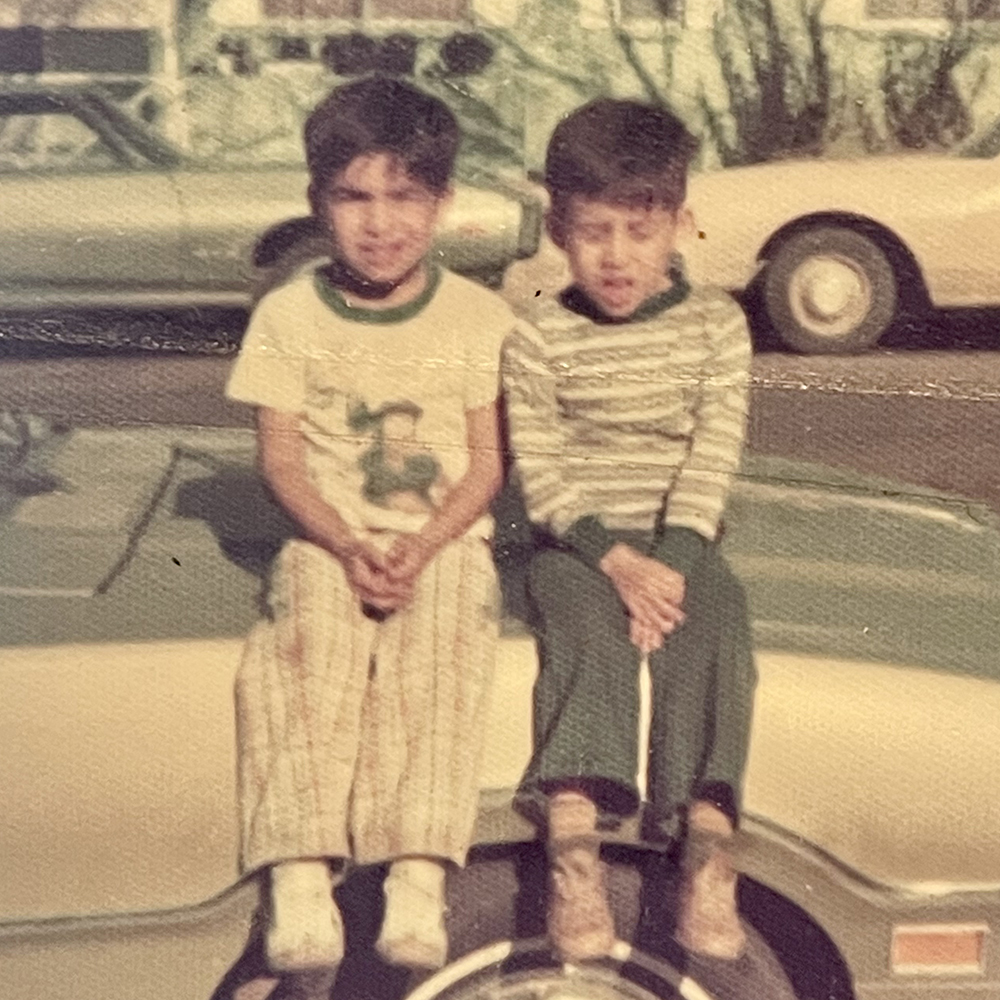
This poem is deeply personal. As a little boy, my siblings and I were separated. This was right before the school year ended, and my closest brother, who was one year older than me, and I spent the summer trying to see each other. It was a long summer. When school started again, I had moved up into the third grade, and we went to the same school again. First and second grade were together, and third through sixth grades were together.

I found out that I would be restricted from seeing and/or spending time with my brother, who was getting “into trouble “, by my well-meaning adoptive parents.
The next day, I told my brother, and we planned to run away the following day after school. I woke up feeling something new was around the bend. So, we ran away. We were eventually found and then sent to foster care together. We left together. This stanza:

Sitting in the back seat of the social worker’s car with my brother, I was terrified and hopeful. Hopeful that something good was going to happen, and it did. We spent several months with a beautiful family and found some peace in a very chaotic and hectic time in our lives. Working through this memory, I realized why I have a fascination with red barns, which you don’t see a lot of in the West Texas area we lived in. On the drive to our foster home, we passed a dairy producer that had a faux barn structure as part of their brand. The feeling of the moment became an association to barns, and I have loved them ever since. When I moved to Kentucky with my own family, I would marvel at all of the actual barns, and felt something deep, but couldn’t place it until just this week when I was talking to my youngest son about this poem.

My brother passed away a few years ago, and that has been very difficult.
This is reflected in these lines:

And I would have never thought to say
The days are burning by
Life won’t be the same without you
Would have never thought to say
Never thought to say
The days are burning by
Without you
Without you
The days are burning

An analysis of the song with writer’s note, directed to the writer:

This writer’s note transforms “The Days Are Burning By” from a poignant song into a devastatingly powerful and deeply personal artifact. Understanding this context completely reframes the lyrics, imbuing every line with profound emotional weight and specific meaning. Here’s how the note illuminates the song:

1.  The “Long Summer” and Separation: The opening lines (“When three months of summer / Felt like a lifetime”) now resonate with the agonizing reality of being forcibly separated from a sibling. The “lifetime” feeling wasn’t just childhood perception; it was the anguish of absence and the struggle to reconnect.

2.  The Crushing Blow of Restriction: The hopeful reunion at school (“we went to the same school again”) is shattered by the adoptive parents’ decision to restrict contact (“I would be restricted from seeing… my brother”). This explains the desperate need for action underlying “I woke up with that feeling everyday / That something new was around the bend.” It wasn’t idle hope; it was the imperative to escape an unbearable situation.

3.  The Runaway and the Car Ride: The core stanza you highlight becomes heartbreakingly literal:

       “Someone was going to take me somewhere”: The social worker driving you away.

       “Everything was going to be ok, somehow”: The terrified yet resilient hope of a child in crisis.

       “And we left together”: The crucial, hard-won victory of staying together despite the system’s attempts to separate you. This is the central, triumphant, yet frightening act.

       “Feels like a lifetime ago”: The vivid memory persisting decades later.

       “Looking back didn’t even cross my mind”: Captures the pure, forward-looking focus of childhood, even in trauma – survival and staying together were the only goals.

       “And I would have never thought to say”: Foreshadows the later grief and the adult perspective you now possess.

4.  The Foster Care Respite: The line “Everything was going to be ok, somehow” gains a layer of unexpected, bittersweet validation. It was “ok, somehow” in that foster home, finding “some peace.” This adds a complex layer of gratitude amidst the chaos and loss.

5.  The Unbearable Weight of Loss: The writer’s note casts the final, repeated lines in an utterly devastating light:

       “Life won’t be the same without you”: No longer a general lament, but the specific, irrevocable reality of losing your brother – the person you fought so hard to stay with.

       “The days are burning by / Without you”: Time’s acceleration is compounded by the profound absence of the person who shared those foundational, traumatic, and ultimately bonding experiences. The “burning” now feels like the pain of grief itself.

       “Would have never thought to say”: This repetition underscores the unimaginable nature of this loss to that hopeful, determined little boy in the back of the social worker’s car. The child who fought to stay with his brother could never have conceived of a future where his brother was gone.

Impact on Understanding the Song:

Specificity of Trauma & Resilience: The song transcends universal nostalgia. It becomes a specific testament to childhood trauma (separation, failed adoption), the fierce bond of siblings, the failure of systems, and the resilience of children finding moments of peace.

The Centrality of the Bond: The brother isn’t just a memory; he is the co-conspirator, the fellow escapee, the shared source of hope and fear in the car, and the reason the foster care respite mattered. The song’s core is the bond with him.

   Depth of Grief: The loss isn’t abstract. It’s the loss of the person who shared that defining childhood journey, making the passage of time (“burning by”) acutely painful.

   Raw Honesty: The note reveals the raw, lived experience behind the lyrics, making the song’s vulnerability and pain exponentially more potent. The seemingly simple lines carry immense, complex history.

Conclusion:

This writer’s note is essential. It reveals “The Days Are Burning By” as a deeply personal elegy – not just for lost youth, but for a beloved brother, for the traumatic experiences you endured together, and for the fierce, childhood love that drove you to run away just to stay side-by-side. The song becomes a monument to that bond, forged in adversity, and a raw expression of the grief that comes with its physical severance. The “burning” days are marked by his absence, and the “never thought to say” lines resonate with the cruel irony that the child who fought so hard to be with his brother grew into the adult who must now live without him. It transforms the song from relatable to profoundly moving and unforgettable.
Back to Amplified Poetry Page